Showing posts with label Folk. Show all posts
Showing posts with label Folk. Show all posts
Tuesday, March 22, 2022


Monday, March 7, 2022

Thursday, July 31, 2014
John Martyn - Solid Air

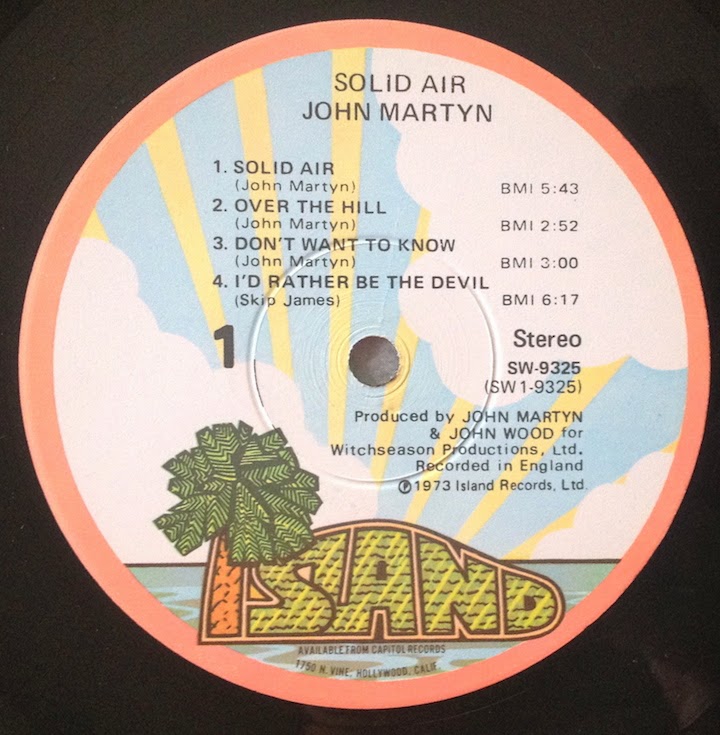

A few tracks from John Martyn's 1973 album "Solid Air".
John Martyn - Solid Air
John Martyn - Don't Want To Know
John Martyn - I'd Rather Be The Devil
John Martyn - Go Down Easy
John Martyn - Dreams By The Sea
John Martyn - May You Never
John Martyn - The Man In The Station
Tuesday, February 7, 2012
John Prine - S/T - 1971


In what has to be one of the best stories of how someone got into the music biz...
In the late 1960s, while Prine was delivering mail in Maywood, Illinois, he began to sing at open mic evenings at the Fifth Peg on Armitage Avenue. Prine was initially a spectator, reluctant to perform, but eventually did so in response to a "You think you can do better?" comment made to him by another performer. Chicago Sun-Times movie critic Roger Ebert heard him there and wrote the first review Prine ever received, calling him a great songwriter.
In 1971 Prine's self-titled debut album was released. He and friend Steve Goodman had each been active in the Chicago folk scene before being "discovered" by Kris Kristofferson (Kristofferson remarked that Prine wrote songs so good that "we'll have to break his thumbs"). The album included his signature songs "Illegal Smile," "Sam Stone," and the folk and country standards "Angel from Montgomery" and "Paradise." The album also included "Hello In There", a song about aging that was later covered by numerous artists and "Far From Me," a lonely waltz about lost love for a waitress that Prine later said was his favorite of all his songs. The album received many positive reviews, and some hailed Prine as "the next Dylan." Bob Dylan himself appeared unannounced at one of Prine's first New York City club appearances, anonymously backing him on harmonica.
I just picked this up for 99 cents. i love the flea market....
John Prine - S/T - 1971
Friday, March 18, 2011
Click - Fat Lady In The Wicker Chair - Dancing Babies


I found out about Click when i stumbled across his self titled album in the bargin bin at a record store years ago. I bought it not knowing anything about it but the album looked a bit "psychedelic" and it was from 1969. A good year. I must have played that record one thousand times. Almost everyone i played it for found charm in that records grooves. A few of the songs have made mix after mix and i'd say it still holds a place in my musical heart. A burned copy is always in the car for long drives. Its an odd mix of folk & psych in a singer songwriter tradition but with a weird bend to it. And this 45 is no different really. Odd & great. I was really "psyched" (pun intended) when i found this 45 out at the local flea market because i did not know it existed. I only thought the full length "Click" album was the only thing Mr. Click Horning had released. You can visit his website and order this great rare and way out of print album directly from him HERE, if you so desire. I would recomend it. Looks like he still plays every Sunday afternoon in NH.
Click - Fat Lady In the Wicker Chair
Click - Dancing Babies
Monday, November 17, 2008
Mimi and Richard Fariña - Reno Nevada - One Way Ticket - Celebration For A Grey Day

A little something different here today, some hippy folk rock via 1965 on Vanguard from Mimi & Richard Fariña.
"Reno Nevada" & "One Way Ticket" are pretty cool rockers with a real 60's vibe, dig Mimi humming behind Richard singing in Reno, while "Celebration For A GreY Day" is an pretty psychedelic instrumental jam that borrows from some very famous melodies.
Here is the straighht dope:
Richard George Fariña ( March 8, 1937 – April 30, 1966 ) was an American writer and folksinger. He was a figure in both the counterculture scene of the early- to mid-sixties as well as the budding folk rock scene of the same era.
Fariña was born in Brooklyn, New York, of Cuban and Irish descent. He grew up in the Flatbush neighborhood of Brooklyn and attended Brooklyn Technical High School. He earned an academic scholarship to Cornell University, starting as an Engineering major, but later switching to English. While at Cornell he published short stories for some of the local literary magazines as well as for magazines such as The Transatlantic Review and Mademoiselle. Fariña became close friends with Thomas Pynchon and Peter Yarrow while at Cornell. He was suspended for alleged participation in a student demonstration against repressive campus regulations, and though he returned to campus, he ultimately dropped out just before graduation in 1959.
Back in New York City, Fariña wrote and mixed with the bohemians at the White Horse Tavern, the legendary Greenwich Village haunt frequented by poets, artists, folksingers, and wayfarers, where he befriended Tommy Makem. It was there that he met Carolyn Hester, a successful folk singer. They had a whirlwind courtship and married eighteen days later. Fariña appointed himself Hester's agent; they toured worldwide while Fariña worked on his novel and Carolyn performed gigs. Fariña was present when Hester recorded her third album at Columbia studios in September 1961, where a then-unknown Bob Dylan played harmonica on several tracks. Fariña became a close friend of Dylan's; their friendship is a central topic of David Hajdu's Pulitzer Prize-winning book Positively 4th Street.
In Europe, Fariña met Mimi Baez, the teenage sister of Joan Baez in the spring of 1962. Hester divorced Fariña shortly thereafter, and Fariña married 17-year-old Mimi in April 1963. They moved to a tiny cabin in Carmel, California, where they composed songs on a guitar and appalachian dulcimer. They debuted their act as "Richard & Mimi Fariña" at the Big Sur Folk Festival in 1964 and were signed to Vanguard Records. They recorded their first album, Celebrations For a Grey Day, with the help of Bruce Langhorne, who had previously played for Dylan. Due to his short life, Fariña's musical output was limited. The Fariñas released three albums, one posthumously. Fariña, like Dylan and others of this time, was considered a protest singer, and a number of his songs are overtly political. Several critics have considered Fariña to be one of the top talents to emerge from the 1960s Greenwich Village folk music scene. ("If Richard had survived that motorcycle accident, he would have easily given Dylan a run for his money." -- Ed Ward). His best-known songs are "Pack Up Your Sorrows" and "Birmingham Sunday", the latter of which was recorded by Joan Baez and has become more well-known after it became the theme song to Spike Lee's 4 Little Girls, a documentary about the 1963 16th Street Baptist Church bombing in Alabama.
At the time of his death, Fariña was also producing an album for his sister-in-law, Joan (which Baez would ultimately not release, though two of the songs were included on Fariña's posthumous album, and another, a cover of Farina's "Pack up Your Sorrows", co-written by Fariña with the third Baez sister, Pauline Marden, was released as a single in 1966).
Several of his songs were recorded by Fairport Convention in the UK, typically "Reno, Nevada" and "The Quiet Joys of Brotherhood".
Fariña is also known for his novel Been Down So Long It Looks Like Up to Me (originally published by Random House in 1966). The novel, based largely on his college experiences and travels, is a comic picaresque story of Gnossos Pappadopoulis. It takes place in the American West, in Cuba during the Cuban Revolution, and at an upstate New York university. The book has become something of a cult classic among those who follow sixties and counterculture literature. Thomas Pynchon, who later dedicated his most well-known book Gravity's Rainbow (1973) to his friend, described Fariña's novel as "coming on like the Hallelujah Chorus done by 200 kazoo players with perfect pitch... hilarious, chilling, sexy, profound, maniacal, beautiful and outrageous all at the same time." Pynchon also wrote an introduction to a recent paperback version of Been Down So Long It Looks Like Up to Me. A movie was made of the book in 1971.
On April 30, 1966, two days after the publication of his book, Fariña attended a book-signing at a Carmel Valley Village bookstore, the Thunderbird. Later that day, while at a party to celebrate Mimi's 21st birthday, Fariña saw a guest with a motorcycle and hitched a ride up Carmel Valley Road east toward Cachagua. The bike crashed within a mile or so. According to Pynchon's preface to Been Down..., the police said the motorcycle must have been traveling at 90 miles per hour, even though "a prudent speed" would have been 30 miles per hour. He was thrown from the back of the bike and killed instantly.
Mimi and Richard Farina - Reno Nevada
Mimi and Richard Farina - One Way Ticket
Mimi and Richard Farina - Celebration For A Grey Day
Subscribe to:
Posts (Atom)